High Fashion Industry a Model Qualifications
We looked at 19 years of covers to find how Vogue represents women of all shades
Code and design by Amber Thomas & Jan Diehm
Inorthward 2014, Lupita Nyong'o, a Mexican-Kenyan actress and model, revealed that she used to pray for lighter skin. For most of her childhood, she saw her dark, "dark-shaded" complexion equally "an obstacle to overcome."
Lupita was talking virtually a facet of racism called colorism. It's the idea that, for people of colour, lighter peel is more desirable. In the same way that white women will have an easier time than women of color, light-skinned women of color will have an easier time than night-skinned women of color. So even though racial and ethnic multifariousness in manner and the media is improving, nighttime-skinned women notwithstanding aren't getting the representation they deserve.
To investigate this, we looked at the covers of Faddy magazine, a breastwork of fashion that has been reporting on and setting trends for over a century. Vogue may exist hiring women of many races, simply are they representing women of all shades? (Vogue did not reply to multiple requests for comment.)
The Calculations
To analyze the last nineteen years of Vogue covers, we calculated how light a model'southward skin looks in each photo. That is, how the photographers and editors of Vogue chose to brandish her.
Here's how the calculation works:
Measuring merely the lightness of a model's peel tone in a item photo allows u.s. to compare all of our models based on a single metric.
Peel Tones
Inorth the past 19 years, at that place accept been 228 issues of Vogue, with a total of 262 female person comprehend models. Permit's look at where these women fall on the lightness spectrum:
Covers are also afflicted by forces you can't see. Last year, Vogue's parent company Condé Nast lost roughly $120 million, and the magazine's younger sibling, Teen Faddy, ditched print operations in favor of cyberspace-just digital covers.
Money woes are nothing new for magazines. They've been scrambling for at least the last decade and accept been forced to continually reexamine their covers — how they look, what they sell, and who they characteristic. In the late 1990s, Vogue'south editor-in-chief Anna Wintour made a big change and replaced cover models with cover celebrities — the conventional wisdom being that the near familiar faces would bring in bigger profits. Of form, this reliance on the most familiar faces didn't e'er overlap with the near diverse faces.
Today, there's a trend to focus more on how a cover feels and less on what information technology sells. In an interview with The Ringer, Vanity Fair deputy editor Claire Howorth said "The aspiration has shifted to being not so much near textile things but to a kind of cultural aspiration."
But as magazines fight for survival with dwindling resources and a shrinking audience base, that doesn't mean they get a pass on beingness both thorough and thoughtful.
Tokenism
Fiftyet's take a closer look at the cover models at the far-ends of this graphic. Beneath, you'll find the five darkest and lightest Faddy cover models of the past nineteen years.
Darkest Cover Models

Lupita Nyong'o - 2018

Lupita Nyong'o - 2015

Michelle Obama - 2009

Serena Williams - 2015

Lupita Nyong'o - 2014
Lightest Cover Models
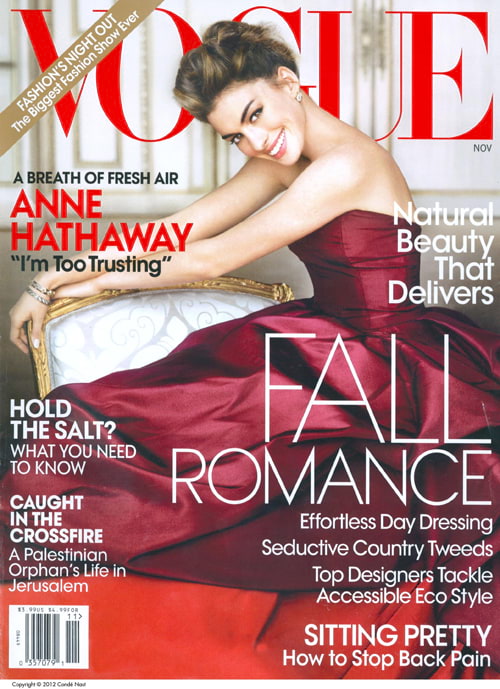
Anne Hathaway - 2010

Jessica Chastain - 2013

Claire Foy - 2018

Amy Adams - 2014

Natalia Vodianova - 2004
You may have noticed something curious near the v darkest models: three of the faces (a full 60%) are Lupita's. At this end of the spectrum, they're repeatedly showcasing the same woman. Alternatively, on the lite end of the spectrum, we see five distinct faces.
At a glance, yous could contend that Vogue covers are diverse, or at least that they have gotten more diverse in recent years. There are covers with black women and covers with dark-skinned women. But when we really look, it's easy to see that the majority of the blackness women are calorie-free-skinned and the majority of night-skinned women are really a single person.
And black models have actually been told by the fashion industry that a single person IS enough representation. In an interview with the Times of London, Chanel Iman said "Designers have told me, 'We already found one blackness daughter. We don't demand you lot anymore.'"
When an organization uses just one or two members of an underrepresented group in order to achieve the bare minimum of diversity, it'southward chosen tokenism. Lupita is a successful and talented dark-skinned model and actress who deserves to be on the cover of Faddy, but by no means is she the only ane in the manufacture (Viola Davis, Khoudia Diop, Astou, Letitia Wright, and Aja Naomi Rex, to proper noun a few). Despite ignoring these other women, Faddy can point to a "token" as proof that they are various, while leaving Lupita responsible for representing a huge swath of readers.
Repeat Models
Although Lupita does business relationship for the majority of dark-skinned models, she's not the merely model who has graced the cover of Vogue more than in one case. Sixty-two models (fifty% of our dataset) take been featured at to the lowest degree twice.
When nosotros look at the skin tones of ane woman who has appeared on lots of covers, we find something interesting: they tend to vary quite a fleck. Lighting, staging, and post-photographic processing (i.e., Photoshop) all play a role in creating the skin tone that we really see on the mag'southward cover. Frequently, that skin tone ends up actualization lighter than a model'due south bodily colour and magazines get called out for "whitewashing." Ultimately, the same adult female can finish up looking quite dissimilar depending on who's shooting and editing her.
Peradventure the best instance of this is Rihanna. Across her 5 Vogue covers, her skin tone lightness spanned 40% of the lightness range that we institute among cover models.
It'due south impossible for us to know what contributed the most to the dramatic differences in her pare tone across these five covers, but it should remind us that issues of colorism won't be fixed but by hiring encompass models of diverse shades. Vogue has had exactly one black lensman in 125 years of publication. It should go without maxim that blackness photographers with lots of experience photographing black models will practise a better chore. It should too get without saying that magazines should be barred from using excuses like "In that location aren't any qualified blackness photographers" or "Nosotros can't detect blackness photographers." Information technology'south 2019, the internet exists, and there's an independent database of photographers of color.
Explore the repeat model below. Click on any model to view all of her covers.
Darker Shades Lighter Shades
Conclusion
So what can we say well-nigh Vogue magazine? They've certainly come a long way since their kickoff black cover model, back in the seventies. Ethnic diversity and representation is improving.
Last September, a black adult female (Beyoncé) was shot by Vogue's beginning-always black embrace photographer (Tyler Mitchell) for the almost of import month in the style mag calendar. That's progress, just it doesn't change the fact that Lupita is the merely dark-skinned professional model on the comprehend of Faddy in the past nineteen years. Vogue (and the unabridged fashion industry) tin do better.
Methods
The covers were downloaded from The Vogue Archive (paywall, merely most public libraries have memberships) . But covers from January 2000 through December 2018 were used, since earlier covers were scanned and had inconsistent color quality.
The covers were fed into a script that identified the faces of models and cropped the images down to size. The script produced many imitation positives, which were identified and removed by hand, forth with the faces of male models.
For each face up, several k-means clustering models were fit. The clustering models varied in terms of which features were used (some combination of the rgb and hsl color values) as well as how many clusters were formed (two or three). Since the style of the covers varied then differently, unlike clustering models did a good task at identifying the peel. The script filtered out just the pixels that were adamant by the computer model to contain peel, and calculated and stored the median rgb color, equally well as the corresponding lightness value. Ii people double checked that the clustering models were outputting valid results that visually made sense based on the input photos, and the results of all of the valid clustering models were averaged together.
0 Response to "High Fashion Industry a Model Qualifications"
Post a Comment