J&m Home Fashions Denim Band Pillow
| J | |
|---|---|
| J j ȷ | |
| (See below) | |
 | |
| Usage | |
| Writing system | Latin script |
| Type | Alphabetic |
| Language of origin | Latin language |
| Phonetic usage | [j] [dʒ]~[tʃ] [x~h] [ʒ] [ɟ] [ʝ] [dz] [tɕ] [gʱ] [t]~[dʑ] [ʐ] [ʃ] [c̬] [i] |
| Unicode codepoint | U+004A, U+006A, U+0237 |
| Alphabetical position | 10 |
| History | |
| Development |
|
| Time menstruum | 1524 to nowadays |
| Descendants | • Ɉ • Tittle • J |
| Sisters | І Ј י ي ܝ ی ࠉ 𐎊 ዪ Ⴢ ⴢ ჲ ☞ ☚ |
| Variations | (See beneath) |
| Other | |
| Other letters commonly used with | j(10), ij |


J, or j, is the tenth letter in the modern English alphabet and the ISO basic Latin alphabet. Its usual name in English is jay (pronounced ), with a now-uncommon variant jy .[1] [2] When used in the International Phonetic Alphabet for the y audio, it may be called yod or jod (pronounced or ).[3]
History [edit]
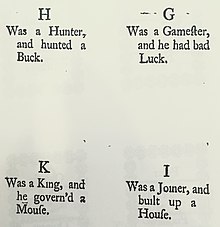
Children'southward volume from 1743, showing I and J considered as the same letter
The letter J used to be used as the swash letter I, used for the letter I at the stop of Roman numerals when following some other I, as in XXIIJ or xxiij instead of XXIII or xxiii for the Roman numeral representing 23. A distinctive usage emerged in Middle High German.[4] Gian Giorgio Trissino (1478–1550) was the first to explicitly distinguish I and J every bit representing carve up sounds, in his Ɛpistola del Trissino de le lettere nuωvamente aggiunte ne la lingua italiana ("Trissino'due south epistle about the letters recently added in the Italian language") of 1524.[5] Originally, 'I' and 'J' were different shapes for the same letter of the alphabet, both equally representing /i/, /iː/, and /j/; however, Romance languages developed new sounds (from one-time /j/ and /ɡ/) that came to be represented as 'I' and 'J'; therefore, English J, acquired from the French J, has a sound value quite dissimilar from /j/ (which represents the initial sound in the English language language word "yet").
Pronunciation and use [edit]
| Near mutual pronunciation: /j/ Languages in italics practise not use the Latin alphabet | ||||
|---|---|---|---|---|
| Linguistic communication | Dialect(s) | Pronunciation (IPA) | Environs | Notes |
| Arabic | Standard; most dialects | /dʒ/ | Latinization | |
| Gulf | /j/ | Latinization | ||
| Sudanese, Omani, Yemeni | /ɟ/ | Latinization | ||
| Levantine, Maghrebi | /ʒ/ | Latinization | ||
| Azeri | /ʒ/ | |||
| Basque[half dozen] | Bizkaian | /dʒ/ | ||
| Lapurdian | /j/ | also used in southwest Bizkaian | ||
| Low Navarrese | /ɟ/ | also used in due south Lapurdian | ||
| High Navarrese | /ʃ/ | |||
| Gipuzkoan | /ten/ | also used in eastward Bizkaian | ||
| Zuberoan | /ʒ/ | |||
| Catalan | /ʒ/ or /dʒ/ | |||
| English | /dʒ/ | |||
| Finnish | /j/ | |||
| French | /ʒ/ | |||
| Hindi | /dʒ/ | |||
| Hokkien | /dz/~/dʑ/ | |||
| /z/~/ʑ/ | ||||
| Igbo | /dʒ/ | |||
| Indonesian | /dʒ/ | |||
| Japanese | /dʑ/~/ʑ/ | /ʑ/ and /dʑ/ singled-out in some dialects, see Yotsugana | ||
| Kiowa | /t/ | |||
| Konkani | /ɟ/ | |||
| Korean | North | /ts/ | ||
| /dz/ | afterwards vowels | |||
| South | /tɕ/ | |||
| /dʑ/ | after vowels | |||
| Kurdish | /ʒ/ | |||
| Luxembourgish | /j/ | |||
| /ʒ/ | Some words | |||
| Malay | /dʒ/ | |||
| Mandarin | Standard | /tɕ/ | Pinyin latinization | |
| /ʐ/ | Wade–Giles latinization | |||
| Manx | /dʒ/ | |||
| Oromo | /dʒ/ | |||
| Pashto | /dz/ | |||
| Portuguese | /ʒ/ | |||
| Romanian | /ʒ/ | |||
| Scots | /dʒ/ | |||
| Shona | /dʒ/ | |||
| Somali | /dʒ/ | |||
| Spanish | Standard | /x/ | ||
| Some dialects | /h/ | |||
| Swahili | /ɟ/ | |||
| Tamil | /dʑ/ | |||
| Tatar | /ʐ/ | |||
| Telugu | /dʒ/ | |||
| Turkish | /ʒ/ | |||
| Turkmen | /dʒ/ | |||
| Yoruba | /ɟ/ | |||
| Zulu | /dʒ/ | |||
English [edit]
In English language, ⟨j⟩ about commonly represents the affricate /dʒ/. In Onetime English, the phoneme /dʒ/ was represented orthographically with ⟨cg⟩ and ⟨cȝ⟩.[7] Under the influence of Sometime French, which had a similar phoneme deriving from Latin /j/, English scribes began to apply ⟨i⟩ (later ⟨j⟩) to stand for word-initial /dʒ/ in Old English language (for example, iest and, later jest), while using ⟨dg⟩ elsewhere (for instance, hedge).[vii] After, many other uses of ⟨i⟩ (after ⟨j⟩) were added in loanwords from French and other languages (e.thousand. adjoin, junta). The outset English language language volume to make a clear distinction between ⟨i⟩ and ⟨j⟩ was the King James Bible 1st Revision Cambridge 1629 and an English language grammar book published in 1633.[eight] In loan words such as bijou or Dijon, ⟨j⟩ may correspond /ʒ/. In some of these, including raj, Azerbaijan, Taj Mahal, and Beijing, the regular pronunciation /dʒ/ is really closer to the native pronunciation, making the use of /ʒ/ an example of hyperforeignism, a type of hypercorrection.[9] Occasionally, ⟨j⟩ represents the original /j/ sound, as in Hallelujah and fjord (run into Yodh for details). In words of Spanish origin, where ⟨j⟩ represents the voiceless velar fricative [x] (such equally jalapeño), English speakers usually gauge with the voiceless glottal fricative .
In English language, ⟨j⟩ is the fourth least oftentimes used letter in words, being more frequent only than ⟨z⟩, ⟨q⟩, and ⟨x⟩. It is, however, quite common in proper nouns, specially personal names.
Other languages [edit]
Germanic and Eastern-European languages [edit]
The slap-up majority of Germanic languages, such as German language, Dutch, Icelandic, Swedish, Danish and Norwegian, apply ⟨j⟩ for the palatal approximant /j/, which is usually represented by the letter ⟨y⟩ in English. Notable exceptions are English language, Scots and (to a bottom caste) Luxembourgish. ⟨j⟩ also represents /j/ in Albanian, and those Uralic, Slavic and Baltic languages that use the Latin alphabet, such as Hungarian, Finnish, Estonian, Shine, Czech, Serbo-Croation, Slovak, Slovene, Latvian and Lithuanian. Some related languages, such every bit Serbo-Croatian and Macedonian, also adopted ⟨j⟩ into the Cyrillic alphabet for the same purpose. Because of this standard, the lower case alphabetic character was chosen to be used in the IPA every bit the phonetic symbol for the sound.
Romance languages [edit]
In the Romance languages, ⟨j⟩ has generally developed from its original palatal approximant value in Latin to some kind of fricative. In French, Portuguese, Catalan (except Valencian), and Romanaian it has been fronted to the postalveolar fricative /ʒ/ (like ⟨s⟩ in English measure). In Valencian and Occitan it has the same audio than in English language, /dʒ/. In Castilian, by contrast, information technology has been both devoiced and backed from an earlier /ʝ/ to a present-day /x/ or /h/,[10] with the actual phonetic realization depending on the speaker's dialect.
Generally, ⟨j⟩ is not usually present in modern standard Italian spelling. Only proper nouns (such as Jesi and Letojanni), Latin words (Juventus), or those borrowed from foreign languages take ⟨j⟩. The proper nouns and Latin words are pronounced as the palatal approximant /j/, while words borrowed from strange languages tend to follow that language's pronunciation of ⟨j⟩. Until the 19th century, ⟨j⟩ was used instead of ⟨i⟩ in diphthongs, as a replacement for final -ii, and in vowel groups (as in Savoja); this rule was quite strict in official writing. ⟨j⟩ is also used to render /j/ in dialectal spelling, e.one thousand. Romanesco dialect ⟨ajo⟩ [ajo] (garlic; cf. Italian aglio [aʎo]). The Italian novelist Luigi Pirandello used ⟨j⟩ in vowel groups in his works written in Italian; he also wrote in his native Sicilian linguistic communication, which still uses the letter of the alphabet ⟨j⟩ to correspond /j/ (and sometimes also [dʒ] or [gj], depending on its environment).[eleven]
Other European Languages [edit]
The Maltese language is a Semitic language, non a Romance language; merely has been deeply influenced past them (especially Sicilian) and information technology uses ⟨j⟩ for the sound /j/ (cognate of the Semitic yod).
In Basque, the diaphoneme represented past ⟨j⟩ has a variety of realizations co-ordinate to the regional dialect: [j, ʝ, ɟ, ʒ, ʃ, x] (the last i is typical of Gipuzkoa).
Non-European languages [edit]
Amidst non-European languages that have adopted the Latin script, ⟨j⟩ stands for /ʒ/ in Turkish and Azerbaijani, for /ʐ/ in Tatar. ⟨j⟩ stands for /dʒ/ in Indonesian, Somali, Malay, Igbo, Shona, Oromo, Turkmen, and Zulu. It represents a voiced palatal plosive /ɟ/ in Konkani, Yoruba, and Swahili. In Kiowa, ⟨j⟩ stands for a voiceless alveolar plosive, /t/.
⟨j⟩ stands for /dʒ/ in the romanization systems of near of the Languages of India such every bit Hindi and Telugu and stands for /dʑ/ in the Romanization of Japanese and Korean.
For Chinese languages, ⟨j⟩ stands for /t͡ɕ/ in Standard mandarin Chinese Pinyin system, the unaspirated equivalent of ⟨q⟩ (/t͡ɕʰ/). In Wade–Giles, ⟨j⟩ stands for Mandarin Chinese /ʐ/. Pe̍h-ōe-jī of Hokkien and Tâi-lô for Taiwanese Hokkien, ⟨j⟩ stands for /z/ and /ʑ/, or /d͡z/ and /d͡ʑ/, depending on accents. In Jyutping for Cantonese, ⟨j⟩ stands for /j/.
The Royal Thai General System of Transcription does non apply the letter ⟨j⟩, although it is used in some proper names and non-standard transcriptions to correspond either จ [tɕ] or ช [tɕʰ] (the latter following Pali/Sanskrit root equivalents).
In romanized Pashto, ⟨j⟩ represents ځ, pronounced [dz].
In Greenlandic and in the Qaniujaaqpait spelling of the Inuktitut language, ⟨j⟩ is used to transcribe /j/.
[edit]
- 𐤉 : Semitic letter Yodh, from which the following symbols originally derive
- I i : Latin alphabetic character I, from which J derives
- ȷ : Dotless j
- ᶡ : Modifier letter small dotless j with stroke[12]
- ᶨ : Modifier letter pocket-sized j with crossed-tail[12]
- IPA-specific symbols related to J: ʝ ɟ ʄ ʲ
- Uralic Phonetic Alphabet-specific symbols related to J:
- U+1D0A ᴊ LATIN Letter Small-scale Capital J [13]
- U+1D36 ᴶ MODIFIER LETTER CAPITAL J [xiii]
- U+2C7C ⱼ LATIN SUBSCRIPT SMALL Letter J [xiv]
- J with diacritics: Ĵ ĵ ǰ Ɉ ɉ J̃ j̇̃
Computing codes [edit]
| Preview | J | j | ȷ | |||
|---|---|---|---|---|---|---|
| Unicode name | LATIN Uppercase LETTER J | LATIN SMALL LETTER J | LATIN Modest Letter DOTLESS J | |||
| Encodings | decimal | hex | dec | hex | dec | hex |
| Unicode | 74 | U+004A | 106 | U+006A | 567 | U+0237 |
| UTF-8 | 74 | 4A | 106 | 6A | 200 183 | C8 B7 |
| Numeric character reference | J | J | j | j | ȷ | ȷ |
| Named character reference | ȷ | |||||
| EBCDIC family | 209 | D1 | 145 | 91 | ||
| ASCII one | 74 | 4A | 106 | 6A | ||
- i Also for encodings based on ASCII, including the DOS, Windows, ISO-8859 and Macintosh families of encodings.
Unicode also has a dotless variant, ȷ (U+0237). It is primarily used in Landsmålsalfabet and in mathematics. It is non intended to exist used with diacritics since the normal j is softdotted in Unicode (that is, the dot is removed if a diacritic is to be placed above; Unicode further states that, for example i+ ¨ ≠ ı+¨ and the same holds truthful for j and ȷ).[15]
In Unicode, a duplicate of 'J' for use as a special phonetic character in historical Greek linguistics is encoded in the Greek script block as ϳ (Unicode U+03F3). It is used to denote the palatal glide /j/ in the context of Greek script. It is called "Yot" in the Unicode standard, after the German name of the letter J.[sixteen] [17] An uppercase version of this letter was added to the Unicode Standard at U+037F with the release of version seven.0 in June 2014.[eighteen] [19]
Wingdings smiley issue [edit]
In the Wingdings font past Microsoft, the letter "J" is rendered as a smiley face (this is distinct from the Unicode code point U+263A, which renders equally ☺︎). In Microsoft applications, ":)" is automatically replaced by a smiley rendered in a specific font face when composing rich text documents or HTML electronic mail. This autocorrection feature can be switched off or changed to a Unicode smiley.[twenty] [21]
Other uses [edit]
- In international licence plate codes, J stands for Nippon.
- In mathematics, j is one of the 3 imaginary units of quaternions.
- Also in mathematics, j is one of the 3 unit vectors.
- In the Metric system, J is the symbol for the joule, the SI derived unit for energy.
- In some areas of physics, electrical engineering and related fields, j is the symbol for the imaginary unit (the square root of −1) (in other fields the letter i is used, but this would be ambiguous as it is too the symbol for current).
- A J can exist a slang term for a joint (marijuana cigarette)
- In the United kingdom of great britain and northern ireland nether the old system (before 2001), a licence plate that begins with "J" for example "J123 XYZ" would represent to a vehicle registered between August i, 1991 and July 31, 1992. Again under the old organization, a licence plate that ends with "J" for instance "ABC 123J" would correspond to a vehicle that was registered between August 1, 1970 and July 31, 1971.[22]
Other representations [edit]
References [edit]
- ^ "J", Oxford English language Dictionary, 2nd edition (1989)
- ^ "J" and "jay", Merriam-Webster's Third New International Lexicon of the English Language, Entire (1993)
- ^ "yod". Oxford English Dictionary (Online ed.). Oxford Academy Press. (Subscription or participating institution membership required.)
- ^ "Wörterbuchnetz". Retrieved 22 December 2016.
- ^ De le lettere nuωvamente aggiunte ne la lingua Italiana in Italian Wikisource.
- ^ Trask, R. L. (Robert Lawrence), 1944-2004. (1997). The history of Basque. London: Routledge. ISBN0-415-13116-2. OCLC 34514667.
{{cite volume}}: CS1 maint: multiple names: authors list (link) - ^ a b Hogg, Richard Grand.; Norman Francis Blake; Roger Lass; Suzanne Romaine; R. W. Burchfield; John Algeo (1992). The Cambridge History of the English language Language. Cambridge University Press. p. 39. ISBN0-521-26476-6.
- ^ English Grammar, Charles Butler, 1633
- ^ Wells, John (1982). Accents of English 1: An Introduction. Cambridge, Un: Cambridge University Printing. p. 108. ISBN0-521-29719-2.
- ^ Penny, Ralph John (2002). A History of the Spanish Language . Cambridge, UK: Cambridge Academy Printing. ISBN0-521-01184-i.
- ^ Cipolla, Gaetano (2007). The Sounds of Sicilian: A Pronunciation Guide. Mineola, NY: Legas. pp. 11–12. ISBN9781881901518 . Retrieved 2013-03-31 .
- ^ a b Lawman, Peter (2004-04-19). "L2/04-132 Proposal to add additional phonetic characters to the UCS" (PDF).
- ^ a b Everson, Michael; et al. (2002-03-twenty). "L2/02-141: Uralic Phonetic Alphabet characters for the UCS" (PDF).
- ^ Ruppel, Klaas; Rueter, Jack; Kolehmainen, Erkki I. (2006-04-07). "L2/06-215: Proposal for Encoding 3 Additional Characters of the Uralic Phonetic Alphabet" (PDF).
- ^ The Unicode Standard, Version eight.0, p. 293 (at the very lesser)
- ^ Nick Nicholas, "Yot" Archived 2012-08-05 at archive.today
- ^ "Unicode Character 'GREEK Letter of the alphabet YOT' (U+03F3)". Retrieved 22 Dec 2016.
- ^ "Unicode: Greek and Coptic" (PDF) . Retrieved 2014-06-26 .
- ^ "Unicode 7.0.0". Unicode Consortium. Retrieved 2014-06-26 .
- ^ Pirillo, Chris (26 June 2010). "J Smiley Outlook Email: Problem and Fix!". Archived from the original on 26 November 2016. Retrieved 22 December 2016.
- ^ Chen, Raymond (23 May 2006). "That mysterious J". The Erstwhile New Thing. MSDN Blogs. Retrieved 2011-04-01 .
- ^ "Motorcar Registration Years | Suffix Number Plates | Platehunter". www.platehunter.com . Retrieved 2018-12-20 .
External links [edit]
 | Wikimedia Commons has media related to J. |
0 Response to "J&m Home Fashions Denim Band Pillow"
Post a Comment