Restaurants Near Fashion Square Mall Charlottesville Va
(Redirected from Fan district)
| Fan Surface area Celebrated District | |
| U.S. National Register of Historic Places | |
| U.S. Historic district | |
| Virginia Landmarks Register | |
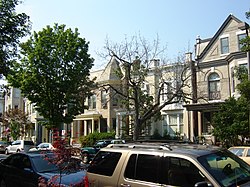 A street in the Fan | |
| Evidence map of Virginia Evidence map of the United States | |
| Location | Roughly divisional by N. Harrison, W. Principal, Due west. Grace and North. Mullberry Sts., Richmond, Virginia |
|---|---|
| Coordinates | 37°33′9″N 77°27′56″Westward / 37.55250°N 77.46556°W / 37.55250; -77.46556 Coordinates: 37°33′9″N 77°27′56″West / 37.55250°North 77.46556°West / 37.55250; -77.46556 |
| Area | 228 acres (92 ha) |
| Builder | Multiple |
| Architectural style | Mid 19th Century Revival, Tardily 19th-20th Century Revivals, Belatedly Victorian |
| NRHP referenceNo. | 85002243[1] |
| VLRNo. | 127-0248 |
| Significant dates | |
| Added to NRHP | September 12, 1985 |
| Designated VLR | Baronial 13, 1985[2] |



The 2200 cake of West Grace Street in Richmond, Virginia.
The Fan is a district of Richmond, Virginia, so named considering of the "fan" shape of the array of streets that extend west from Belvidere Street, on the eastern border of Monroe Park, westward to Arthur Ashe Boulevard. However, the streets rapidly resemble a grid later on they go through what is at present Virginia Commonwealth University. The Fan is one of the easterly points of the metropolis'southward Westward Finish department, and is bordered to the northward by Broad Street and to the south by VA 195, although the Fan District Clan considers the southern edge to exist the properties abutting the s side of Main Street.[3] The western side is sometimes called the Upper Fan and the eastern side the Lower Fan, though confusingly the Uptown district is located near VCU in the Lower Fan. Many cafes and locally endemic restaurants are located here, as well as historic Monument Avenue, a boulevard featuring enormous equine statuary of Civil War Confederate generals and a statue of lawn tennis icon Arthur Ashe. Development of the Fan district was strongly influenced by the Metropolis Cute movement of the tardily 19th century.
The Fan District is primarily a residential neighborhood consisting of late-nineteenth and early-twentieth century homes. It is also dwelling house to VCU'southward Monroe Park Campus, several parks, tree-lined avenues and three of the urban center'due south historical monuments. The District also has numerous houses of worship, and locally owned businesses and commercial establishments. The Fan borders and blends with the Boulevard, the Museum District, and the Carytown district, which features the ornate Byrd Theatre. The advent of the Fan District is frequently compared to that of the Bourbon Street neighborhood in New Orleans although the two places are actually quite different architecturally upon close examination.
Main east-w thoroughfares include Broad Street, Grace Street, Monument Avenue, Patterson Avenue, Grove Avenue, Floyd Avenue, Main Street, Parkwood Ave, and Cary Street.
Compages [edit]
Following a succession of owners, an compages museum, the Virginia Eye for Architecture, took occupancy in 2005 of Co-operative Business firm on Monument Avenue, a residence designed in the Tudor style past the business firm of John Russell Pope in 1914.


The Fan is oft incorrectly described as pregnant for having one of the longest intact stretches of Victorian architecture in the United States, simply well-nigh of it was actually built after the end of the Victorian era and is arguably more Edwardian and Revival in style. Well-nigh all of the housing stock was constructed in the first decades of the twentieth century and exhibits the pared back victorianism of Edwardian architecture. Colonial Revival and American Craftsman compages is common likewise, with Revival architectural types arguably the most common (as was common to the time period) Revivalism (architecture).
Primary architectural styles represented include:
- Italianate
- Richardsonian Romanesque
- Queen Anne
- Colonial Revival
Other architectural styles include:
- Tudor Revival
- Second Empire
- Beaux-Arts
- Art Deco
- Spanish
- Gothic Revival
- Bungalow
- American Craft Movement
- James River Georgian
- Southern Colonial
- Jacobethan (Jacobean Revival)
- Federal
History [edit]

The boundaries of the Fan
In 1817, the Fan was plotted as the village of Sydney on land formerly endemic by William Byrd Ii. Primary development of the Fan occurred afterward the Civil State of war through about 1920. Streetcar lines leading from downtown influenced development; the nation's start electrical streetcar arrangement was inaugurated in Richmond in 1888.
As development increased from downtown at the turn of the 20th century, Franklin street became a fashionable "West End" accost. A desire for a Due west End address drove rapid real estate development of the area, irresolute the expanse from rural tobacco fields in 1880 to beingness almost fully developed country by the 1920s. Equally development accelerated, the Academy of Richmond (then located on Lombardy Street) was moved west to a more than rural location (its nowadays Westhampton location). During the Great Depression, many of the single-family unit homes in the expanse were converted to apartments.
The term "the Fan" was coined in the mid 20th century by a Richmond Times Dispatch editorial, as the appellation "West Cease" no longer applied.
Maps [edit]
- Wikimapia
References [edit]
- ^ "National Register Data Arrangement". National Register of Historic Places. National Park Service. March 13, 2009.
- ^ "Virginia Landmarks Register". Virginia Section of Historic Resources. Archived from the original on 21 September 2013. Retrieved xix March 2013.
- ^ "Archived re-create". Archived from the original on 2013-09-03. Retrieved 2013-08-23 .
{{cite web}}: CS1 maint: archived copy equally title (link)
External links [edit]
- The Fan Commune Clan
- History of the Fan: A series of historical narratives past Fan District Association Historian Gail Zwirner
- Fan of the Fan (community news web log)
- Fan of the Fan: A wait at the history and compages of the Fan Area Historic District
0 Response to "Restaurants Near Fashion Square Mall Charlottesville Va"
Post a Comment